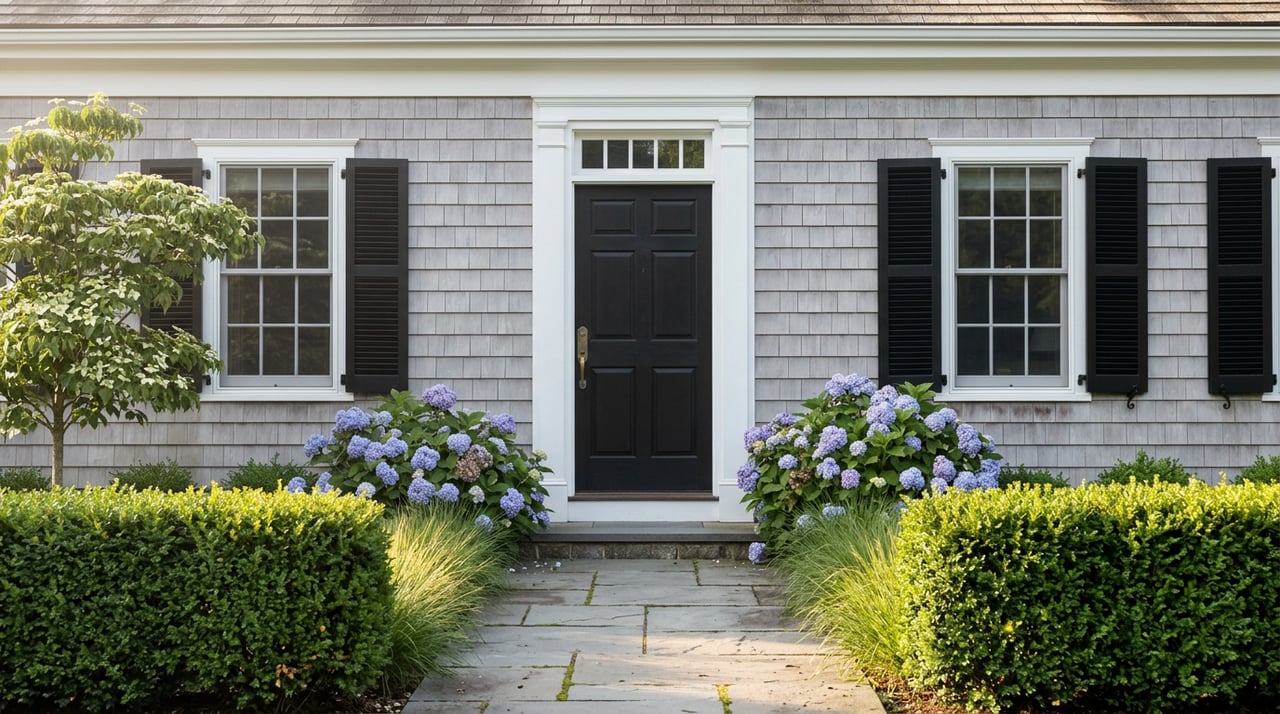
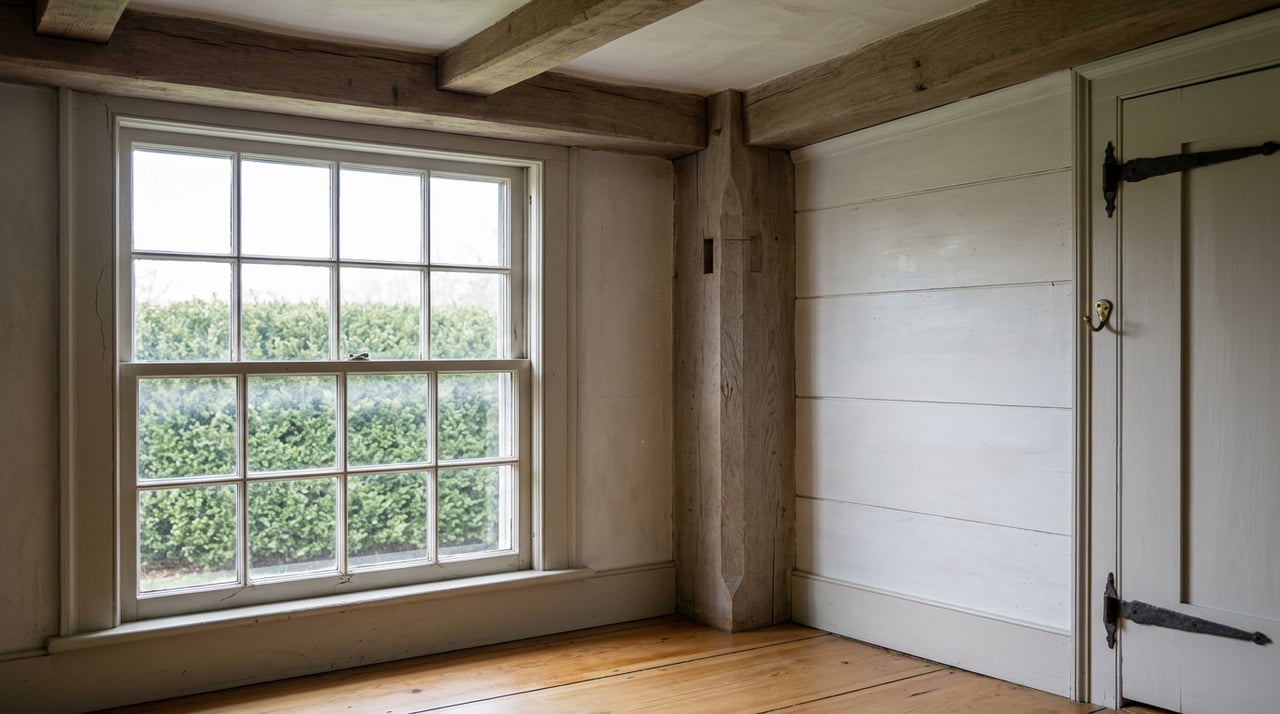
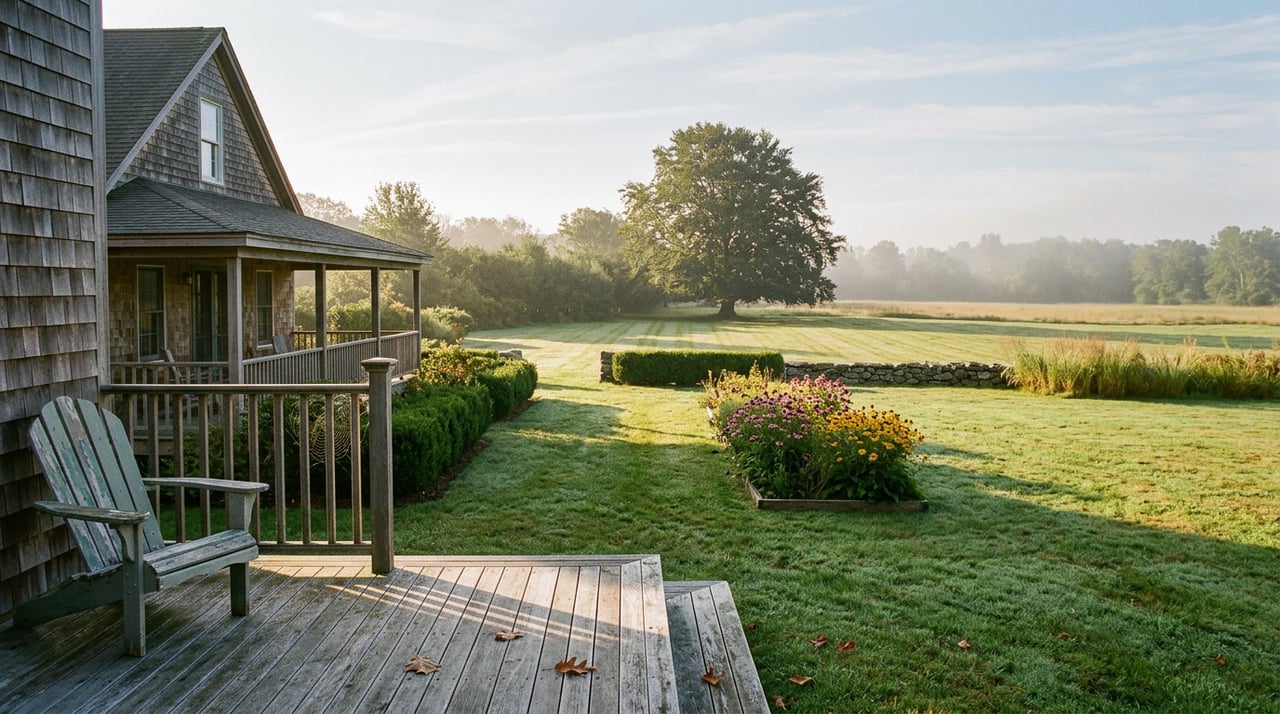
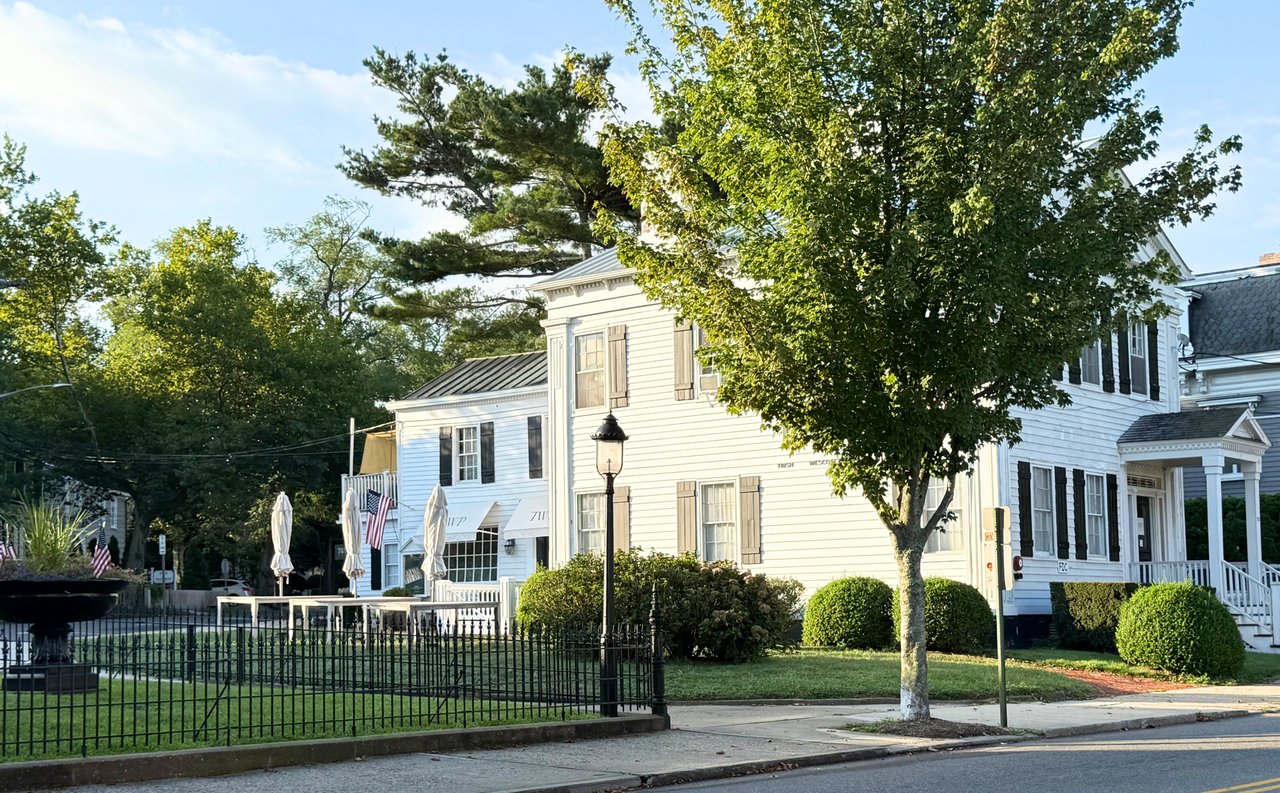
Buyers touring East Hampton Village learn to read listings fast. The phrase "designated village landmark" usually reads as a warning. Expect a preservation board. Expect a capped renovation. Expect friction where a plainer house would let you move quickly.
That instinct is correct almost everywhere else in the country. On a specific, short list of East Hampton Village properties, it is backwards. Preserve the right 300-year-old house and the Village will let you build a second one right next to it, on a lot too small to legally hold two homes under any other circumstance.
A Restriction Built as a Trade
East Hampton Village adopted its timber-frame landmarks law roughly a decade ago, becoming the first municipality in New York State to write this kind of exception into its code. The law applies to about two dozen individually designated structures framed and raised between 1700 and 1850, sited outside the Village's four historic districts. Ordinary Village zoning treats two residences on one small lot as a nonconforming use and prohibits it outright. The timber-frame law carves out a single exception: if the property is one of those two dozen designated landmarks, and it sits outside the historic districts, the owner can preserve the original structure and add a second, modern house on the same land.
The current version of the Village code, amended as recently as November 2024, spells out the ceiling on that second structure. A new accessory dwelling built alongside the preserved landmark cannot exceed 35 percent of the property's allowable floor area or 3,000 square feet, whichever is smaller. If the landmark building itself becomes the accessory dwelling instead, that cap rises to 40 percent or 3,700 square feet. Either way, the accessory unit is limited to four bedrooms. The Village's own historic preservation consultant has described the arrangement plainly: it hands one property owner a density right the house next door does not have, in exchange for keeping a piece of the town's oldest architecture standing.
Proof in Stone on Egypt Lane
The clearest evidence that this law works as intended sits at 13 Egypt Lane, where the Hiram Sanford House, a Cape Cod dwelling once home to the man who ran the Pantigo Windmill, was restored on a lot just under half an acre while a new residence rose beside it. The restoration kept the surviving historic fabric of the original house intact and uncovered original framing that had been buried under later additions. The Village's Design Review Board received the 2014 Commission Excellence Award from the National Alliance of Preservation Commissions for the ingenuity of the underlying law, recognition that reached well beyond East Hampton. The Sanford House restoration later earned its own preservation award from the Village Preservation Society, proof that the mechanism moved from code language into a functioning, awarded project.
That matters for anyone comparing two similarly sized, similarly priced pre-1850 properties in East Hampton. One might carry this designation. The other might not. The difference is not cosmetic. It is buildable square footage that no amount of variance work can otherwise recover on an undersized parcel.
The Village's Other Set of Rules
The exception only works outside the Village's four historic districts, Main Street, Hook, Hunting Land, and Ocean Avenue. Inside those districts, a different and stricter regime governs. Any exterior change beyond normal maintenance requires a Certificate of Appropriateness from the Design Review Board, full stop, and the two-house allowance does not apply. A pre-1850 house on Main Street and a pre-1850 house on Egypt Lane can carry very different rights depending on which side of that boundary line they fall.
The distinction does not stop at the Village line either. East Hampton Town, which governs the hamlets and unincorporated areas outside the incorporated Village, maintains its own separate designation called a special historic landmark, with its own accessory-dwelling allowance and its own caps, most recently amended in 2024 and 2025. A buyer cannot assume that a house built before 1850 automatically qualifies for either program. The designation has to be confirmed address by address, and Village Hall keeps that list.
What This Is Worth at the Closing Table Right Now
The current market gives a sense of what a well-documented historic story is already commanding in East Hampton Village, separate from the timber-frame program itself. A restored Queen Anne Victorian on Huntting Lane closed for $6.15 million in late January 2026. A 7.3-acre compound spanning Hither Lane and Middle Lane, anchored by a circa-1930s house known as Holly Hall, traded for $30 million in a January 2026 sale, one of the largest East Hampton has recorded so far this year.
Neither of those two houses falls inside the 1700 to 1850 window the timber-frame law covers, a Victorian and a 1930s estate are both too young to qualify. But they show what buyers are currently willing to pay for genuine architectural history in the Village when it is documented and presented clearly. Layer the timber-frame program on top of that appetite and the math changes again for the small set of properties it actually touches. A landmark designation on the right lot is not simply a historical footnote. It is a second, legally buildable structure that a plain, unlandmarked lot of identical size and zoning could never hold.
A Few Questions Worth Asking Before You Write an Offer
Does every old house in the Village qualify? No. Only the roughly two dozen properties the Village Board of Trustees has specifically designated as timber-frame landmarks, built between 1700 and 1850, carry this right. Village Hall maintains the official list, and it is worth confirming before assuming either the benefit or the restriction applies.
What if the house sits inside one of the four historic districts? Then the second-house exception does not apply. You are working under Certificate of Appropriateness review through the Design Review Board instead, which governs exterior changes but does not open the door to a second dwelling.
Is the Town of East Hampton's rule the same as the Village's? No. The Town maintains a separate special historic landmark designation outside the incorporated Village, with its own bedroom and floor-area limits. A pre-1850 house does not automatically qualify just because of its age. Jurisdiction and designation both have to be verified.
Reading a historic listing correctly in East Hampton Village means knowing which of these categories a property actually falls into before you decide whether it is a constraint or an asset. Jennifer Friedberg works this kind of detail into every historic-property search from the first conversation, because the difference between a restricted old house and a landmark with real building rights attached is exactly the kind of thing that should be settled before an offer goes in, not after. If you are weighing a pre-1850 property in East Hampton Village, schedule a private consultation and we will walk the designation, the code, and the numbers together before you commit to anything.