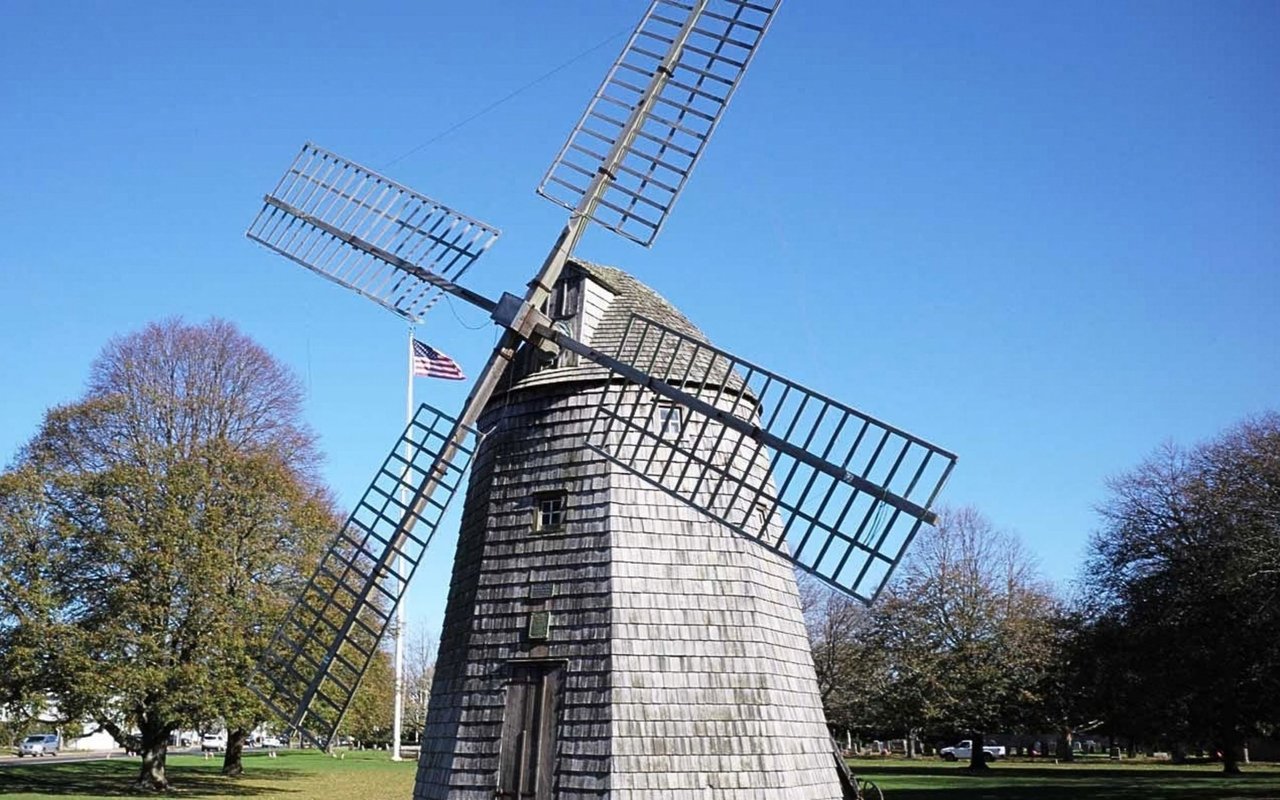
Drive down Montauk Highway past the Village Green this fall and the windmill looks whole again, sails and all, the way it has since a crew of local carpenters finished putting it back together last year. The Corwith Windmill, the shingled landmark that has watched over Water Mill's green since 1813, spent months without its arms while that crew worked through the winter to rebuild it. If you have lived here long enough to have stopped seeing it, that restoration is worth a second look this season. It was the first time the windmill had been fully restored since 1987.
That gap matters more than it sounds. Water Mill is a hamlet that runs on more than one clock at once, and most years those clocks tick along without anyone noticing they are out of sync. This fall several of them are lining up, and the result is a version of "the season is turning" that has nothing to do with a gala or a new restaurant. It has to do with a nonprofit, a farmer, an artist colony, and a windmill that has been anchoring this green for more than two hundred years.
What Actually Happened On The Green
The Corwith Windmill is owned and maintained by the Water Mill Village Improvement Association, a volunteer nonprofit that has held the title since 1934, when the Order of St. Dominic handed it over along with the surrounding common ground. The WMVIA raised $170,000 to fund the restoration, and the work itself was led by Ricky Muller, a Water Mill resident and a descendant of the Corwith family that originally milled grain here. Muller had already restored the hamlet's actual water mill, the building across Montauk Highway on Old Mill Road, and he brought his son Leland Muller onto this project along with Andrew Hurley, a contractor who works out of a shop within walking distance of the green, and craftsman Tom Matthews, who handled the windows. The crew worked through the winter, and the arms went back on the mill last year.
It is worth sitting with how rare this kind of repair actually is. The windmill was fully restored once, in 1987, and had its driveshaft and wind vanes replaced in 2010. Outside of that, it has mostly just stood there, absorbing whatever the weather sent its way. The Corwith mill is a smock windmill, an early design with a stationary tower and a revolving cap that sits directly on a greased curb rather than the rollers later mills used. That older mechanism is part of why it is the smallest and second oldest of the eleven surviving windmills on the South Fork, a stretch of Long Island that has the largest regional cluster of windmills anywhere in the country. It is not a replica. It is the real, working mechanism, and it took a genuinely rare alignment of money, craftsmanship, and volunteer time to keep it that way.
There is a small irony buried in the mill's own history. The Water Mill Museum's own account of the windmill notes that one of the reasons it stopped grinding grain in 1887 was a nearby summer villa whose new landscaping cut off the prevailing wind the sails needed. More than a century later, it is that same pattern of estate-driven change and civic goodwill, this time channeled through a nonprofit instead of a landowner, that keeps the mill standing at all. The wind that once got blocked by a summer house is now the thing the whole restoration exists to catch again.
The Museum Runs On Its Own Calendar
Across Montauk Highway from the windmill, at 41 Old Mill Road, sits the building most people mean when they say "the water mill." It is the actual functioning, water-powered grist mill the hamlet is named for, housed in a structure that is more than 250 years old and doubles as the Water Mill Museum. Water Mill is the only settlement on the South Fork with both a working watermill and a windmill individually landmarked on the National Register of Historic Places, which is a strange kind of civic distinction to hold, but it is Water Mill's own.
The museum keeps hours that have nothing to do with the social season. It is open Sundays from 1 to 4 and closed Monday through Wednesday. Its art gallery, which rotates member work through the season, has three more shows on the 2026 calendar: September 6, September 26, and October 13. None of those dates are tied to a holiday weekend or a benefit. They are simply when the next set of local painters and quilters gets wall space. If you want a low-key excuse to walk the green this fall, that calendar is a better guide than anything with a cocktail hour attached.
The Orchard Does Not Care What The Windmill Is Doing
A few minutes south at 757 Mecox Road, Milk Pail runs its own clock entirely, one set by fruit rather than fundraising. Its U-pick apple, pumpkin, and sunflower season is already underway, and regulars know that Granny Smiths tend to be the ones worth waiting for, usually ready by early September. On Newlight Lane, Babinski's Farm Stand keeps a similar rhythm. What began as Mike Babinski selling heirloom tomatoes off a card table at the roadside has grown into a full stand that runs dawn to dusk from early spring into early fall, selling field produce, local seafood, baked goods, and Mike's own marinara sauce, made in part from whatever tomatoes have not sold by the time the season winds down. Kids climb on the red tractor out front. The Babinskis' dog, Tessa, has apparently made her peace with all of it.
Neither of these places is timing its season around the windmill or the museum. They are timing it around what is actually ripe. That is a useful thing to remember if you have only ever thought of "the change of season" here as something that happens in the social calendar. In Water Mill, it happens in the dirt first.
Three Landmarks, Three Clocks
Landmark | Established | What just happened |
|---|---|---|
Corwith Windmill, the Village Green | Built around 1800, moved to Water Mill in 1813 | Fully restored in 2025, the first full restoration since 1987 |
Water Mill Museum and grist mill, Old Mill Road | Building dates to the 18th century | Fall gallery shows scheduled for September 6, September 26, and October 13, 2026 |
The Watermill Center, 39 Water Mill Towd Road | Founded in 1992 by Robert Wilson | International Summer Program ran July 5 through August 2, 2026, and has now closed for the season |
That last one deserves its own note. The Watermill Center's ten acres of sculpture gardens and studios were full of resident artists this summer, working alongside founder Robert Wilson and his collaborators through the program that ended August 2. If you drove past this July and saw activity on those grounds, that window has now closed. The property will stay quiet with year-round residency work continuing behind the scenes until next summer's program starts again. It is one more example of a Water Mill institution that keeps its own hours, unrelated to the windmill or the orchard, and unrelated to anything happening on Main Street in the villages nearby.
If you want one more marker that the hamlet's calendar is already tilting toward fall, the Garden Conservancy's Open Days season, which is bringing visitors into gardens in Sag Harbor and East Hampton this September, includes a Water Mill address of its own: Donna's Farmette opens its gates as part of the same circuit. It is a small thing, a single afternoon on a single property, but it is one more sign that the hamlet's fall does not announce itself with a single event. It arrives in pieces, on schedules nobody coordinated on purpose.
What This Actually Tells You
None of this is really about a windmill. It is about what it takes to notice a place you already live in. Water Mill does not hand you a single date to mark the season's turn. It hands you a windmill that took $170,000 and a handful of named craftsmen to repair, a museum with its own quiet fall calendar, an orchard that ripens on its own schedule, and an artist residency that just went dark for the year. None of them checked in with each other. All of them happen to be worth walking past this fall, especially the green, where the sails have been back up since last year, the first time that has been true since 1987.
Water Mill has long been one of the Hamptons’ most coveted addresses. Its landscape, history, and distinctive pockets are part of what gives the hamlet its enduring appeal—and why local knowledge matters.
Jennifer Friedberg brings that knowledge and perspective to every real estate conversation.
Considering Water Mill? Let’s talk.